15 December 2025
Ágnes Makai - GOKVI
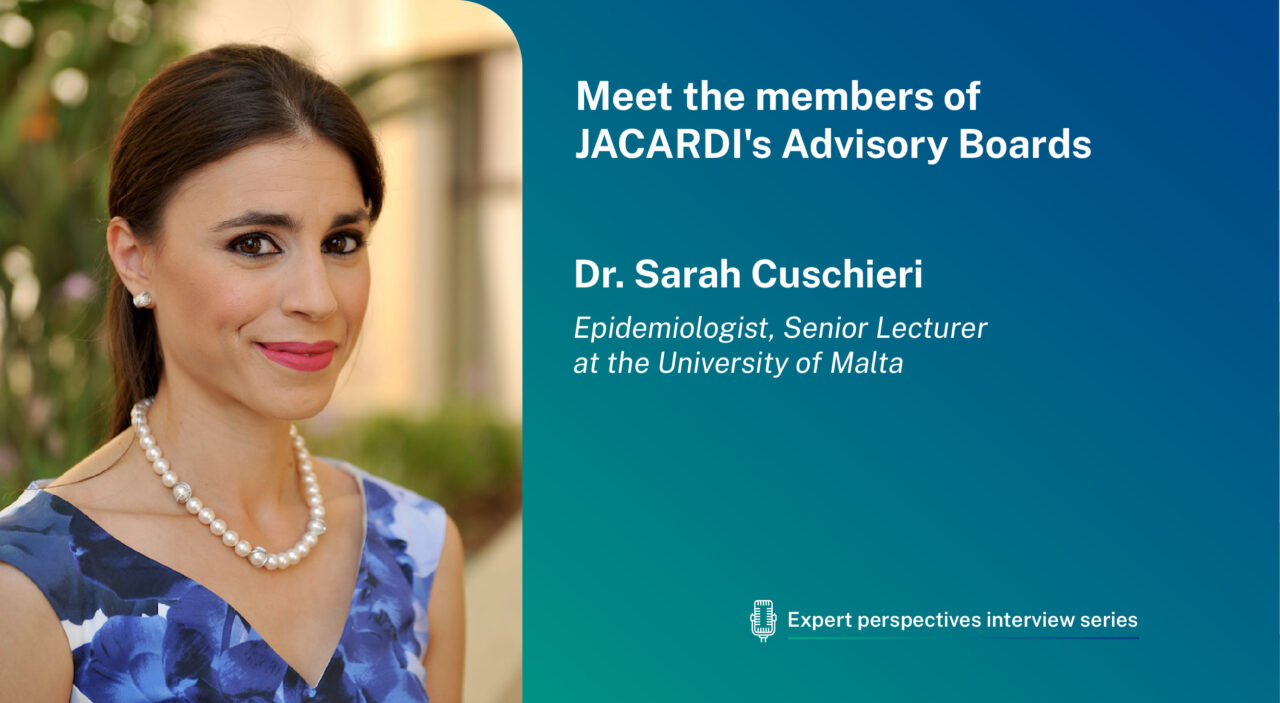
Dr. Sarah Cuschieri, a leading voice in chronic disease epidemiology and small-state health systems, shares her insights on how JACARDI can accelerate Europe’s fight against cardiovascular disease and diabetes. “When every country speaks the same practical language of prevention, collaboration becomes scalable”, she explains. She also reflects on the importance of data, inclusion, and mentoring the next generation, reminding us that effective prevention is both a scientific and a human endeavour.
Drawing on your work in chronic disease epidemiology and the realities of small states, where do you see JACARDI’s greatest leverage in slowing the rise of cardiovascular disease and diabetes across Europe?
Drawing on my experience in chronic disease epidemiology and the realities of small states, JACARDI’s greatest leverage lies in transforming small-state initiatives into the strength of Europe.
First, small states can act as test beds for integrated prevention and care pathways, where whole-population coverage, centralized health systems, and close primary–secondary linkages allow rapid piloting and evaluation of cardiovascular and diabetes interventions. Evidence generated in these compact settings can be rapidly refined and transferred to larger Member States.
Second, small states excel at policy agility. With short governance chains, multidisciplinary teams, and accessible data infrastructures, they can translate guidelines into everyday practice faster than larger systems. Embedding JACARDI’s harmonized tools and care pathway templates in these contexts demonstrates how evidence can move from paper to patient in real time.
Third, small states provide a unique lens on equity and resilience. Their populations often mirror Europe’s diversity within a manageable scale, making them ideal for testing community-level engagement, health-literacy interventions, and cross-sector collaboration for risk-factor reduction.
By harnessing these advantages—rapid implementation, whole-system evaluation, and equitable design—JACARDI can convert its evidence base into practical, scalable prevention and care models that slow the rise of cardiovascular disease and diabetes across Europe.
How does participating in JACARDI advance your organisation’s goals on cardiovascular disease (CVD) and diabetes – whether through data, capacity-building, or policy impact?
From our vantage point at the University of Malta and through our broader collaboration within the Small States Health Platform, participation in JACARDI directly advances our institutional goals in CVD and diabetes prevention by strengthening the bridge between evidence, policy, and practice.
As a small island state with a centralized health system and accessible national datasets, Malta offers a unique setting to pilot integrated chronic disease pathways, risk factor surveillance tools, and community-based prevention models. Through JACARDI, we can both contribute real-world evidence from a small-population context and adapt proven interventions to local realities such as limited specialist capacity and high multimorbidity.
Moreover, JACARDI aligns with the University’s commitment to capacity building and implementation science, empowering clinicians, public health professionals, and researchers to translate data into sustainable prevention and care strategies. By embedding our work within this pan-European network, we ensure that Malta’s experience informs regional learning, while also benefitting from shared innovation to accelerate progress on CVD and diabetes management across small states and beyond.
You’ve often bridged research, policy, and practice. How do you think JACARDI can set a new standard for collaboration – across countries, disciplines, and data systems – so prevention becomes easier to implement and harder to ignore?
JACARDI has the potential to redefine how Europe collaborates on chronic disease prevention by turning fragmentation into function. Its strength lies in uniting researchers, policymakers, and practitioners around a shared implementation framework rather than isolated projects.
From a small-state perspective, success depends on breaking silos through simplicity and shared value. JACARDI can set a new standard by creating common, adaptable prevention “building blocks”, standardized care pathways, minimal data dashboards, and training modules that can be easily embedded into national systems, regardless of size or resources. When every country speaks the same practical language of prevention, collaboration becomes scalable.
Equally important is data solidarity, linking health information systems through harmonized indicators rather than complex infrastructures. This enables meaningful cross-country learning while respecting local capacities and governance.
Finally, JACARDI’s cross-disciplinary model, bringing together clinicians, epidemiologists, behavioural scientists, and community actors makes prevention not only evidence-based but implementable. By focusing on what works in real settings, it can make prevention easier to deliver and harder to ignore, setting a benchmark for how Europe acts collectively against cardiovascular disease and diabetes.
As a female leader in epidemiology who mentors the next generation, what were your key take-aways from the JACARDI General Assembly in Madrid, from a scientific and cultural point of view?
As a female leader in epidemiology, and someone deeply committed to mentoring the next generation, I left the JACARDI General Assembly in Madrid with a renewed sense of both scientific purpose and shared humanity. Scientifically, I want us to consolidate how JACARDI’s pilots are not just generating data, but truly changing practice, showing that prevention of cardiovascular disease and diabetes can be embedded into everyday care, across every health system, large or small.
Culturally, the moment JACARDI turned pink carries special meaning for me. It symbolises equity, voice, and visibility, giving women in science, medicine, and policy the space to lead and shape health agendas. It reminds us that public health is not only about outcomes but about inclusion and compassion.
I left Madrid knowing that we are building a network where collaboration transcends borders and disciplines, and where every young researcher – especially women – can see themselves reflected in leadership, discovery, and change. That, to me, would be the true legacy of JACARDI.
You made it to the top 2% of the most cited scientists in the world for five consecutive years, and you’ve written the book “To Do or Not to Do a PhD?” offering guidance to early-career researchers. What message would you send to young researchers, especially women just starting their careers in public health, particularly when facing various challenges?
I would tell young researchers – especially women – that they belong in this space, even when they have doubts. Every scientist, at every stage, faces moments of uncertainty; what matters is not the absence of doubt, but the courage to keep contributing despite it.
From my own journey, and through mentoring many early-career researchers, I’ve learned that success in public health is rarely a straight line. Structural barriers exist, but so do strong networks, mentors, and communities like JACARDI that value inclusion and collaboration. Seek those spaces that lift you up, and don’t be afraid to take your place at the table.
When I wrote To Do or Not to Do a PhD?, it was to remind researchers that impact isn’t defined by titles or citations—it’s defined by curiosity, persistence, and integrity. Imposter syndrome fades when you realize that public health needs diverse voices, perspectives, and lived experiences.
So my message is simple: be bold, be kind, and keep going. Science is richer, and societies are healthier, when you do.
Dr. Sarah Cuschieri is a Senior Lecturer at the University of Malta, Adjunct Professor at Western University, Canada, and a member of JACARDI’s Scientific Advisory Board. A medical doctor turned epidemiologist, she leads pioneering research into obesity, diabetes and chronic disease across small‑state contexts, heads the Chronic Disease Epidemiology Research Network and serves as Vice‑President of the Chronic Diseases Section of European Public Health Association (EUPHA). Internationally recognized for her scholarship, she ranks among the top 2% of most‑cited scientists.
Learn more about Dr. Cuschieri and her work, or connect on LinkedIn.