11 June 2026
Sinikka Kitö - THL
Small states in Europe, like Malta, provide an important opportunity to advance equity-focused surveillance, as smaller populations, centralised systems, and shorter distances make it easier to gain a comprehensive picture of population health. This data offers important signals for policymaking. As part of JACARDI’s Equity Lens series, this article explores what larger countries can learn from smaller ones, and how population-level surveys on non-communicable diseases could be developed to be more equity-driven, thereby helping to improve health systems so they are suitable for all.
Non-communicable diseases (NCDs) account for over 70% of deaths worldwide. Yet current health monitoring systems do not adequately capture who is affected and why.
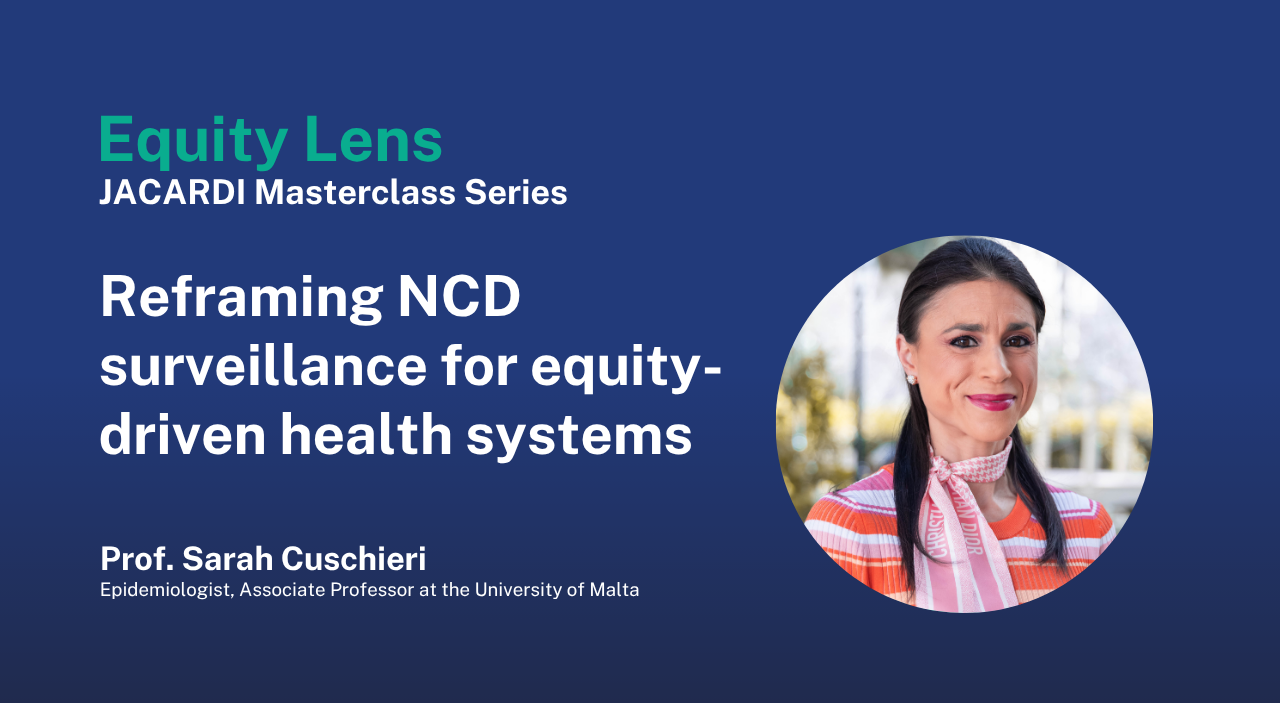
Most surveillance relies on mortality data, hospital records, and self-reported surveys. While valuable, these sources primarily reflect late stages of disease and clinical outcomes. As a result, health systems often measure what is easiest, rather than what matters most for health equity. Prof. Sarah Cuschieri, a leading voice in chronic disease epidemiology and an associate professor at the University of Malta, shared learnings in JACARDI Masterclass titled “Small States, Shared Equity Challenges: Reframing NCD Surveillance for Equity-Driven Health Systems”.
The missing middle of the disease pathway
According to Prof. Cuschieri, a major weakness of current surveillance is that it overlooks large parts of the disease pathway. Undiagnosed conditions, differences in awareness and access, patterns of risk clustering, and variations in treatment adherence and disease control often go unmeasured.
These are not minor gaps, they represent the earliest and most preventable stages of disease. When they remain invisible, disadvantage accumulates over time. This creates a “cascade of inequity,” where people with fewer resources face higher risks, delayed diagnoses, poorer treatment, and ultimately worse outcomes. By the time inequalities appear in morbidity statistics, they are already deeply entrenched and much harder to address.
Making inequities visible through Health Examination Surveys
Health Examination Surveys (HES) offer a more equitable approach to surveillance. Unlike routine data systems, HES are population-based, standardised, and biomarker-integrated. This allows them to identify both diagnosed and undiagnosed disease.
They also reveal how health varies across income, education, sex, age, and other demographic factors. When conducted regularly, HES should be seen not as one-off research projects, but as essential health system infrastructure.
Critically, they help identify who is being left behind, those unaware of their condition, inadequately treated, or unable to achieve disease control. In doing so, they make inequities visible and actionable signals for policy.
Small states as living laboratories for equity-oriented policy
Small states offer an ideal setting for building surveillance systems that support health equity. Their smaller populations and centralized structures allow near‑complete population coverage instead of fragmented data. This makes it easier to move from data to decisions quickly and to clearly see differences between population groups.
They also act as “living laboratories,” where policies can be tested and their effects seen sooner. The fast cycle from data to action means we can learn quickly what works, for whom, and under what conditions. As a result, small states can detect emerging trends early and provide valuable lessons for larger countries.
Towards fairer surveillance and policies
The lessons derived from small states are highly transferable and point toward a necessary reframing of surveillance in larger systems:
- Surveillance must capture the full disease pathway, not just mortality
- Indicators should be systematically disaggregated by socioeconomic factors
- Data sources should be linked to track how inequities develop over the life course
- Surveillance is inherently a political choice, measuring inequity creates accountability
- Designing more effective systems requires sustained political commitment.
Read our interview with Sarah Cuschieri, a member of JACARDI’s advisory board here:
Sarah Cuschieri: Transforming small-state initiatives into the strength of Europe
Further reading:
- Cuschieri et al. (2024) Exploring the determinants associated with adult mortality in Malta: A cohort study between 2014 and 2020. (Public Health in Practise)
- Cuschieri et al. (2024) Exploring the diabesity characteristics and associated all-cause mortality at a population level: results from a small European island state. (Journal of Public Health)
- Margozzini et al. (2024) National health examination surveys; a source of critical data. (Bull World Health Organ)
- Santos et al (2024) The state of health in the European Union (EU-27) in 2019: a systematic analysis for the Global Burden of Disease study 2019. (BMC Public Health)
- Cuschieri et al. (2022) Re-engineering the Cypriot General Healthcare System for Syndemics (Frontiers)
- Cuschieri et al. (2019) Toolkit for the development and implementation of epidemiological surveys in small populations (University of Malta, OAR@UM)
About the JACARDI Equity Lens Series:
Throughout this series, we share why equity and diversity are not optional add-ons but core components of truly equitable healthcare as well as a shared responsibility for everyone working in the field. To share the knowledge generated within JACARDI, the Equity Lens article series draws on the JACARDI Equity Masterclass series that provides an in-depth look into matters related to equity and diversity for JACARDI pilot teams conducting 143 healthcare interventions across Europe. The article series offers insights shared by a diverse pool of public health professionals within the consortium. By looking through an equity lens, we can build a more inclusive system for everyone. Join us in learning how an equity lens can shape daily practice and drive meaningful change.
Read the previous articles in the series:
→ JACARDI’s 4Cs framework for advancing equity and diversity
→ Antiracism is integral to reducing health inequalities