12 May 2026
Cristina Cebrián Méndez - CNIC
Cardiovascular disease remains the leading cause of death in the European Union. Yet the risk of dying from it can vary dramatically depending on where people live, reflecting persistent inequalities in prevention, healthcare systems, and public health policies. The Safe Hearts Plan, unveiled by the European Commission on 16 December 2025, as part of an overall health package, offers a chance to close these gaps and advance a shared vision of longer, healthier lives for all Europeans.
What if your country of residence could triple your risk of dying from heart disease?
This reality is one of the key challenges addressed by the EU Safe Hearts Plan, which places a strong focus on geographical inequalities in cardiovascular health across the European Union. The Plan highlights that cardiovascular death rates can be more than six times higher in some Member States than in others, alongside major differences in access to high-quality care and health outcomes.
Across the region, cardiovascular disease (CVD) remains the leading cause of death, yet outcomes vary dramatically between countries. In Bulgaria, for example, the risk of dying from CVD is nearly three times higher than in Denmark, a gap driven not by biology but by differences in prevention, access to care and public health policies. [1]
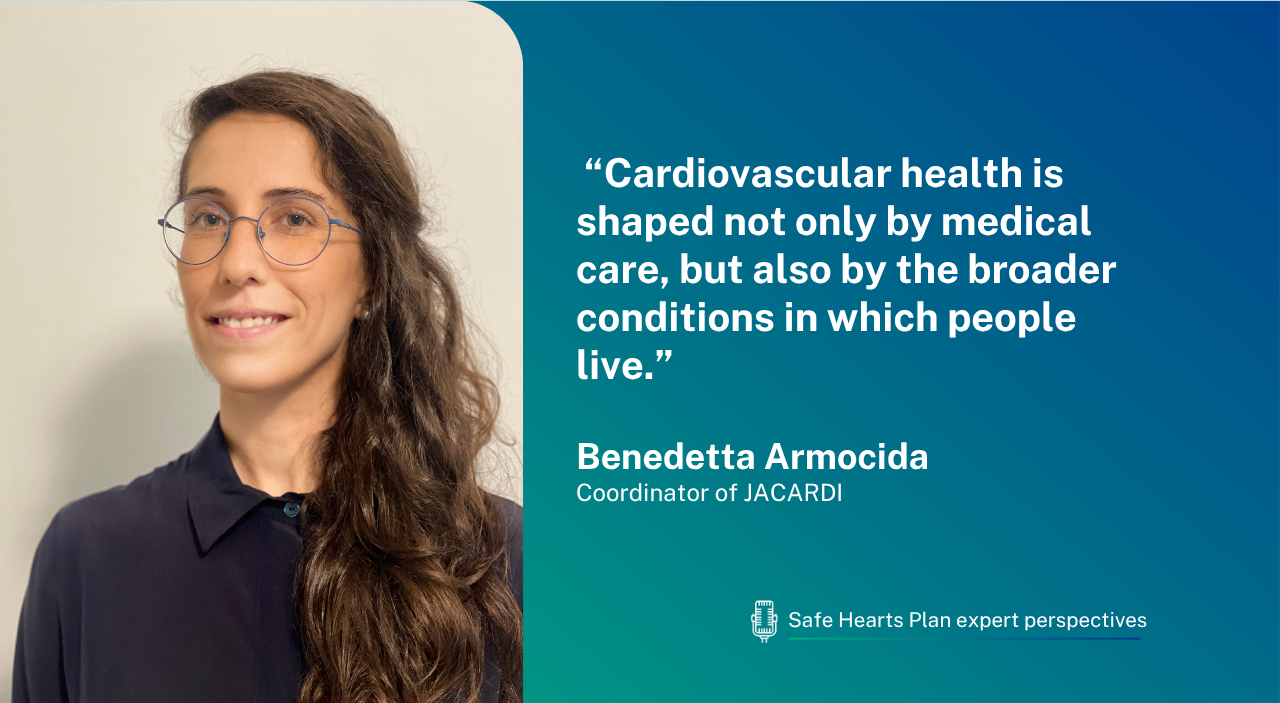
As Dr Benedetta Armocida, coordinator of JACARDI, explains: “These disparities remind us that cardiovascular health is shaped not only by medical care, but also by the broader social, economic and environmental conditions in which people live.
Addressing them therefore requires a strong and sustained public health approach, one that prioritises prevention, strengthens health systems, and promotes equity in access to effective care and healthier environments. The Safe Hearts Plan offers an important opportunity to reinforce collaboration across countries and sectors, supporting a shared vision for Europe where progress in cardiovascular health benefits all communities and contributes to longer, healthier lives for everyone.”
Progress, but not equally shared
Europe has made significant progress in reducing deaths from CVD over the past decades thanks to advances in treatment and prevention. Yet these gains have not been evenly distributed across the region.
In 2021, CVD still accounted for nearly 28% of deaths in Western Europe, with age-standardised mortality rates of around 107 deaths per 100,000 people. Behind these averages lie stark national differences in risk factors, healthcare systems and prevention policies. [2]
Some countries have demonstrated what is possible when prevention becomes a policy priority. Finland, for example, achieved an 82% reduction in cardiovascular mortality among working-age men between 1972 and 2012 through the North Karelia Project, a pioneering initiative that targeted smoking, cholesterol levels and blood pressure at the community level. The programme demonstrated how sustained prevention policies can dramatically improve cardiovascular health. [3]
Today, similar efforts continue. In Finland, the Finnish Institute for Health and Welfare (THL) is leading a pilot project within JACARDI’s work on screening high-risk populations. The project evaluates how well cardiovascular risk scores predict 10-year CVD risk among migrant populations of Russian, Somali and Kurdish origin, and explores whether recalibrating these tools could improve prevention strategies for diverse populations.
This is just one example among 143 pilot actions implemented across Europe under JACARDI, reflecting a wide geographical diversity and a broad range of health system contexts and target groups. By sharing knowledge and experience across countries, these initiatives help build a stronger evidence base and support the development of more effective and equitable cardiovascular prevention strategies.
Risk factors that still shape Europe’s heart health
Where people live can have a profound impact on their cardiovascular health, a phenomenon often referred to as the “postcode effect”. Beyond individual lifestyle choices or genetic predisposition, factors such as income, education, living conditions, access to healthcare, environmental exposure and local prevention policies all play a crucial role in shaping cardiovascular risk.
Recent evidence highlights how these factors translate into measurable health outcomes. A 2024 study published in JMIR Public Health and Surveillance, analysing 24 Western European countries, found strong associations between cardiovascular mortality and factors such as smoking prevalence and exposure to air pollution. Environmental policies can have a measurable impact: between 2010 and 2019, Europe saw a 19% reduction in heart-disease deaths linked to improvements in air quality. [2]
Despite this progress, many European countries continue to exceed the air pollution thresholds recommended by the World Health Organization. Prevention strategies, including screening programmes and health literacy initiatives, also vary widely between countries. These differences contribute significantly to the persistent cardiovascular health gap across Europe.
The cost of inaction
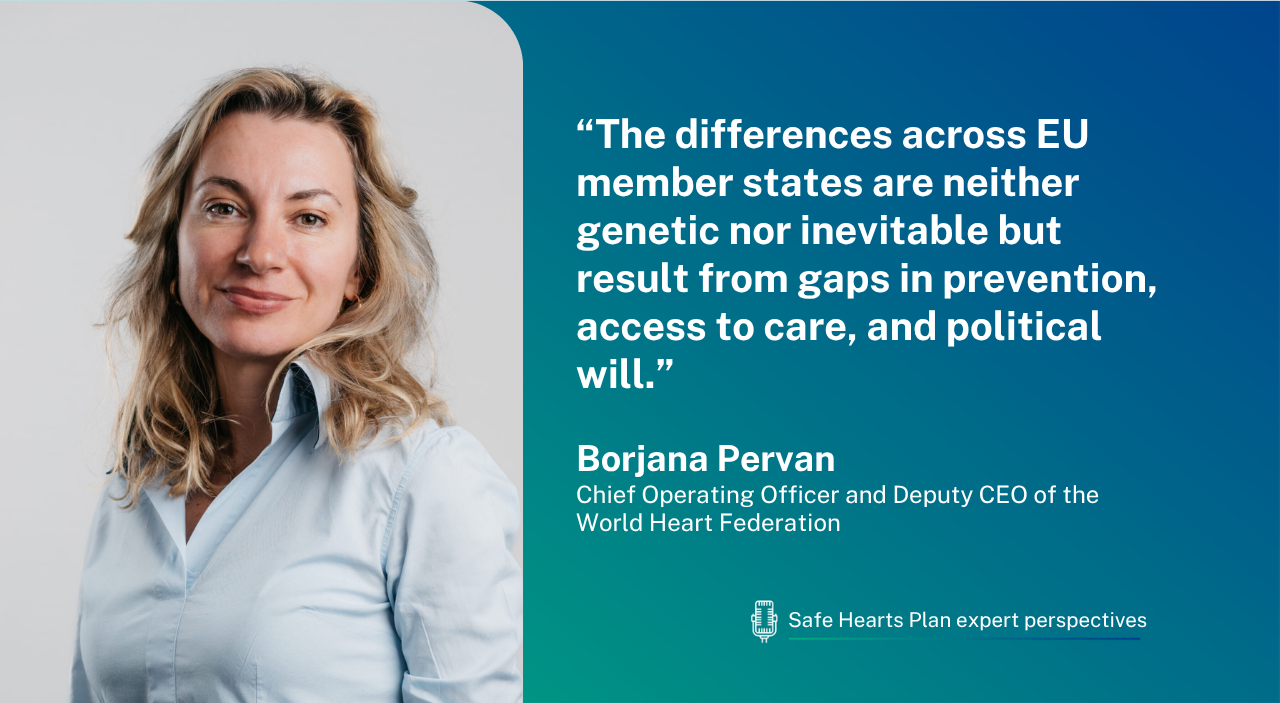
Beyond the human toll, CVDs impose a significant economic burden, with CVD-related expenditures averaging 630 euros per person in the EU in 2021. As Borjana Pervan, Chief Operating Officer and Deputy CEO of the World Heart Federation, explains:
“In today’s Europe, like elsewhere in the world, where you live still defines your cardiovascular risk. The differences across EU member states are neither genetic nor inevitable but result from gaps in prevention, access to care, and political will. We know what works to close these divides. What’s missing is the sustained commitment to apply it, everywhere, for everyone.”
She adds: “Failure to act comes at a cost: CVD already drains over €280 billion from Europe’s economy every year. With the Safe Hearts Plan now in place, the priority must be to ensure that knowledge is matched by policies and translated into action across all Member States.”
Bridging Europe’s cardiovascular divide
The persistence of these inequalities is one of the key reasons why the European Commission launched the Safe Hearts Plan, aimed at strengthening cardiovascular prevention and care across the EU. Evidence suggests that many disparities in cardiovascular outcomes are avoidable.
According to the JACARDI Context Analysis, differences in cardiovascular health across Europe are closely linked to variations in prevention policies, healthcare system capacity and the implementation of effective cardiovascular health strategies. The analysis also shows that only around half of the EU countries examined have national strategies for cardiovascular screening or health literacy, highlighting the need for stronger and more consistent public health measures.
As the EU moves forward with the Safe Hearts Plan, initiatives like JACARDI play a key role in turning ambition into action. By providing expert guidance, practical experience, and answering to the European Commission’s Call for Evidence, this joint action helps inform initiatives such as the upcoming EU protocol on health checks. Its cross-border collaboration also demonstrates how evidence-based policies and coordinated action can help reduce cardiovascular inequalities and move closer to a shared goal: longer, healthier lives for people across Europe.
With work advancing across all stages of the patient journey, JACARDI is generating valuable evidence across a wide range of contexts and populations. Looking ahead, 2027 will be a key milestone to bring this evidence to 21 countries and help shape national cardiovascular health plans and local policies. By translating and integrating this knowledge across the region, the initiative aims to reduce geographic disparities in prevention, access to care and policy implementation, ensuring that everyone, regardless of where they live, can benefit.
This work aligns with flagship actions under the Plan, such as “EU cares for your heart”, which aim to strengthen national cardiovascular health plans and translate prevention into practice. By sharing and scaling evidence across countries, JACARDI contributes to reducing disparities and improving cardiovascular health outcomes across Europe.
About this series
This article is part of the “Following the Safe Hearts Plan: JACARDI Insights Series”, developed by JACARDI.
The series explores how the EU Safe Hearts Plan, launched by the European Commission on 16 December 2025, is being translated into practice across Europe, highlighting evidence, policy developments and real-world implementation experiences from different health systems.
Through collaboration with a wide range of partners across Europe, including international organisations, patient associations, other European Joint Actions, and global public health bodies, the series aims to unpack how cardiovascular health policies can be translated into concrete action, bridging research, prevention strategies and health system implementation. It also features insights from across the JACARDI community, from the Coordination team and Work Package leaders to pilot voices and implementation experts working directly on the ground.
By combining data, expert perspectives and country-level examples, the series supports a shared understanding of how Europe can reduce cardiovascular inequalities and improve health outcomes for all citizens.
Sources:
[1] Nick Townsend, Melanie Nichols, Peter Scarborough, Mike Rayner, Cardiovascular disease in Europe — epidemiological update 2015, European Heart Journal, Volume 36, Issue 40, 21 October 2015, Pages 2696–2705
[2] Mubarik S, Naeem S, Shen H, Mubarak R, Luo L, Hussain S, Hak E, Yu C, Liu X. Population-Level Distribution, Risk Factors, and Burden of Mortality and Disability-Adjusted Life Years Attributable to Major Noncommunicable Diseases in Western Europe (1990-2021): Ecological Analysis. JMIR Public Health Surveill 2024;10:e57840
[3] Puska P, Jaini P. The North Karelia Project: Prevention of Cardiovascular Disease in Finland Through Population-Based Lifestyle Interventions. Am J Lifestyle Med. 2020 Mar 19;14(5):495-499. doi: 10.1177/1559827620910981. PMID: 32922234; PMCID: PMC7444010.
[4] WHF welcomes the first EU Cardiovascular Health Plan