Making screening count: what JACARDI’s Short Guide to Screening offers
Screening can identify health risks and diseases before symptoms appear, creating a valuable window for prevention and early intervention. It supports earlier diagnosis and enables health systems to respond sooner. Screening also helps people understand their personal risks.
From European policy to national implementation
JACARDI’s Short Guide to Screening provides policymakers and public health professionals with a structured framework and practical recommendations for planning and implementing screening activities. Developed through a major collaborative effort across the JACARDI consortium, the guide brings together the expertise and evidence generated through the Joint Action’s work on screening. With the European Commission’s proposal for a Council Recommendation on cardiovascular health checks published during EU Screening Week, this collective work has now found its way into European policy. The guide is referenced in the proposal, while its practical guidance can help support Member States in translating the new recommendations into local action.
Identifying risk is useful only when clear follow-up actions are in place. Effective screening programmes must reach the right people, use reliable screening methods, and lead to access to appropriate prevention, diagnosis, treatment or support.
JACARDI’s Short Guide for Screening Individuals at Increased Risk of Developing Cardiovascular Diseases and Type 2 Diabetes helps putting these essential elements together, and offers practical guidance for designing and implementing screening programmes adapted to local needs.
Why screening matters
Many of the risks for cardiovascular disease (CVD) and type 2 diabetes (T2D) can develop without noticeable symptoms. Screening programmes use health checks, measurements, or questionnaires to identify people who may be at increased risk or who may already have an undiagnosed condition.
This creates an opportunity to act before health conditions become more severe. When screening is well targeted and linked to appropriate support, it can raise awareness, guide preventive action, enable earlier diagnosis and help health systems direct resources where they can make the greatest difference.
Different goals, different screening approaches
Screening can support prevention in several ways. It can identify people at increased risk before disease develops, detect an existing disease at an earlier stage, or identify co-morbidities among people already living with CVD or T2D. While the guide outlines how screening can contribute at different stages of prevention, its principal focus is identifying increased risk as part of primary prevention.
The same tools used for screening can also support population-level health. The key difference lies in how the information is used. Population-level monitoring helps authorities understand trends and plan public health actions. Screening for individual health outcomes should provide each participant a clear result and, where needed, a route to further assessment, prevention, or care.
Screening is more than a test
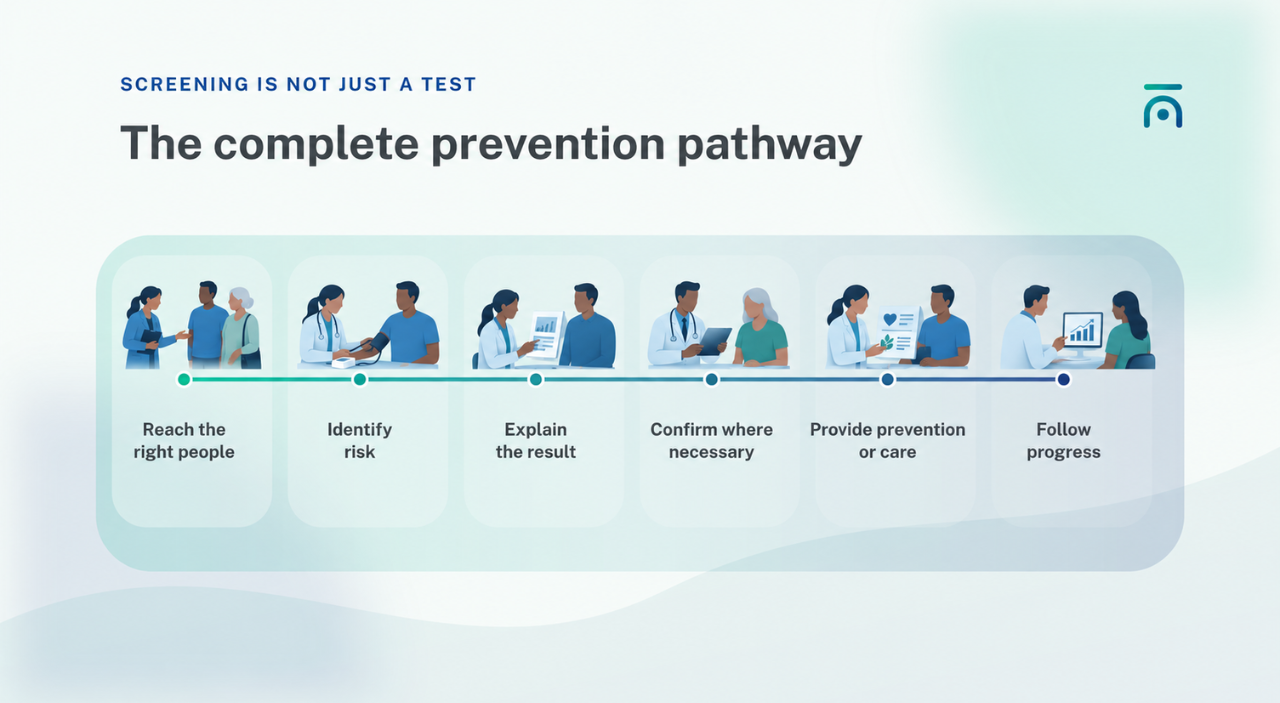
A health check should be part of a complete prevention pathway. People need to understand why they are being screened, what their results mean, and what they should do next. At the same time, health services must be prepared to provide further assessment, preventive support, and when needed, diagnosis or treatment.
Without these links, screening risks becoming a measurement without an outcome. To be both effective and ethical, each step should connect seamlessly to the next, guiding people towards appropriate prevention, care, or support.
How JACARDI’s Screening Guide helps
Developed under the guidance of Hanna Tolonen, leader of JACARDI’s Work Package on screening high-risk populations and individuals, the Short Guide to Screening brings together expertise from JACARDI’s work on screening. It provides a structured approach for planning screening activities for CVD and T2D.
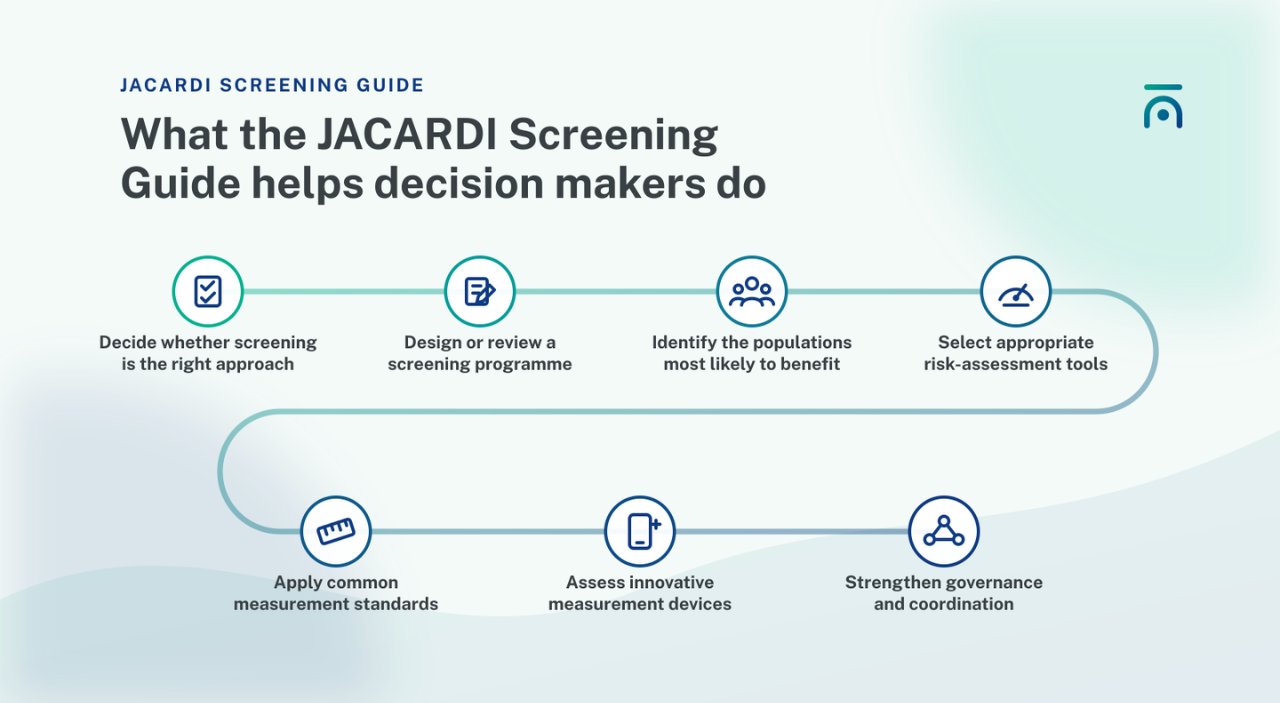
The guide outlines the key decisions that need to be made before a programme begins. It covers target population, risk assessment tools, measurement protocols, innovative screening technologies, and programme coordination. It also includes supporting resources and an evaluation template to help decision-makers assess a proposed or existing screening programme.
Making the right decision before screening begins
Screening programmes require time, funding, trained professionals and follow-up capacity. Before investing these resources, decision-makers need to consider whether screening is the most appropriate response to a health problem and whether the expected benefits outweigh the potential costs and harms.
The Short Guide to Screening supports this decision in two stages. First, it examines whether the disease, available evidence, and possible interventions provide a strong rationale for screening. It then considers whether screening is appropriate in a specific country or region, taking into account population needs, health inequalities, available resources, and the organisation of care.
Designing screening around the people it should serve
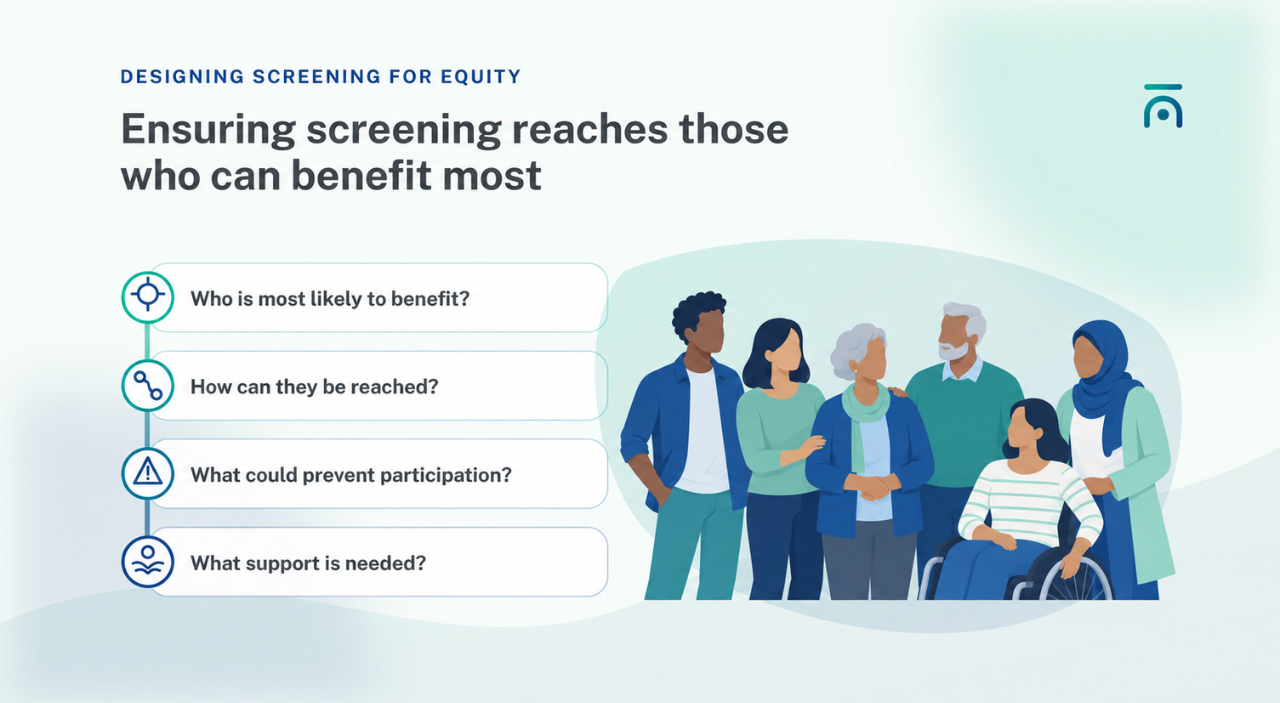
The impact of a screening programme depends largely on who it reaches. Effective programmes identify the groups most likely to benefit, consider how they can be reached, and address the barriers that may prevent participation.
The guide helps users define the target population and assess whether people living in vulnerable situations may be at risk of being overlooked. This makes equity an integral part of programme design from the beginning, rather than a concern identified only after inequalities emerge in the results.
Selecting the right risk-assessment tool
Many tools are available for estimating the risk of CVD and T2D, but different settings call for different approaches. A tool that performs well in one population may be less accurate in another. Some tools require laboratory results, while others rely on information that can be collected quickly and at a lower cost.
The Short Guide to Screening helps users choose the most appropriate tools by considering the population, intended outcome, regional relevance and available data. JACARDI’s interactive Risk Assessment Toolkit complements this guidance by allowing users to compare existing risk scores and identify those most closely aligned with their needs.
Explore the JACARDI Risk Assessment Toolkit
Creating reliable and comparable data
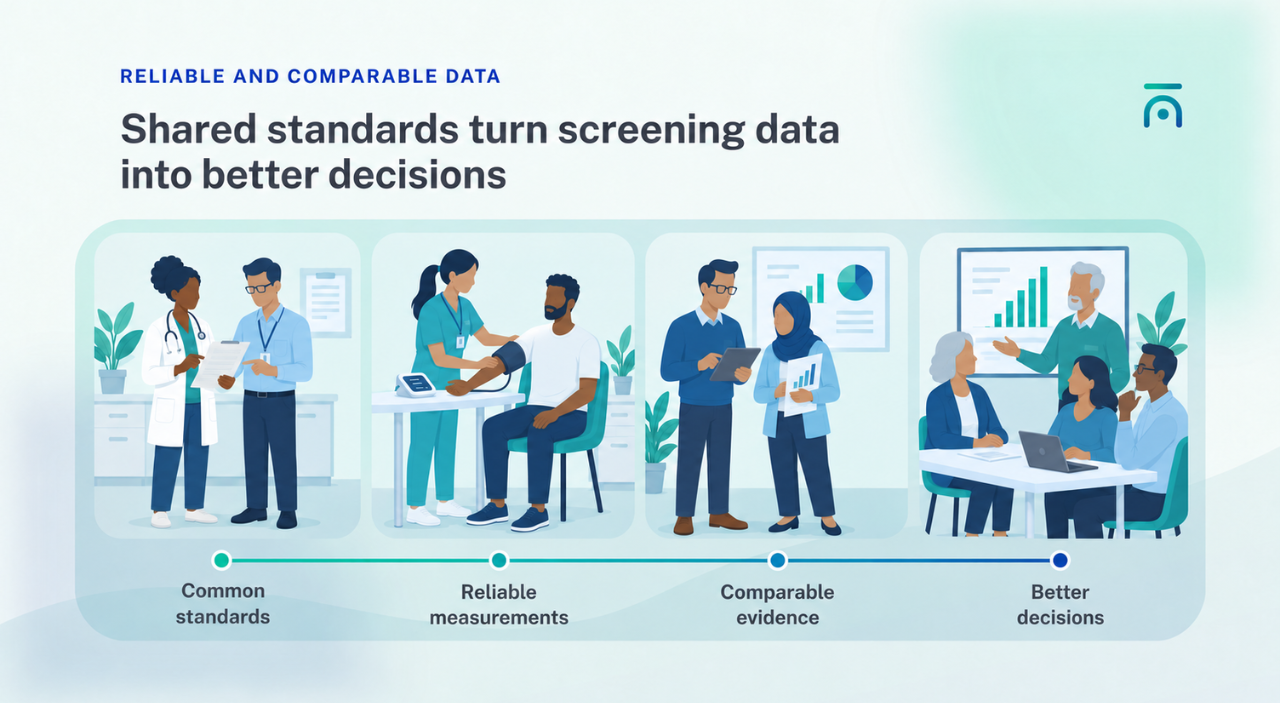
Screening results are only as reliable as the measurements they are based on. Differences in how blood pressure, blood glucose, cholesterol, or body measurements are taken can affect the accuracy of results and make comparisons between individuals, populations, and programmes more difficult.
The guide summarises recommended measurement protocols and directs readers to recognised technical standards for collecting high-quality data. This helps health systems interpret results, compare programmes, evaluate what works, and make informed decisions about future improvements.
Using innovative devices without compromising quality
As digital health technologies become more widely available, self-measurement tools and other innovative devices may seem an attractive way to make health checks more accessible and convenient. However, before they can be used in screening programmes, there must be sufficient evidence that they are accurate, validated, and suitable for the intended purpose.
Based on the evidence currently available, the Short Guide to Screening does not recommend the use of innovative self-measurement devices for screening. Instead, it highlights the need for further research and emphasises that these devices should not replace clinically validated methods or professional assessment.
Read more about JACARDI’s research on self-measurement tools.
Connecting the pieces through stronger governance
Delivering an effective screening programme requires coordination across many stakeholders, including public health authorities, healthcare professionals, laboratories, data systems, community organisations and the people invited to participate. Without clear governance, these different components can become fragmented, reducing the programme’s ability to translate screening results into timely action.
To address this challenge, JACARDI recommends a central governance structure for CVD and T2D screening. Bringing together evidence, standards, tools, and implementation experience supports more consistent decisions, better use of resources and stronger links between screening, prevention and care.
A timely contribution to European health checks
JACARDI’s Short Guide to Screening was developed alongside the European Commission’s work on its proposal for cardiovascular health checks, as part of the consortium’s wider work on screening. It was a substantial collaborative effort, bringing together 29 contributors from across JACARDI’s European network, representing national public health institutes, universities, regional health authorities and organisations represented on JACARDI’s Advisory Board:
- Finnish Institute for Health and Welfare (THL) leading JACARDI’s Work Package on Screening
- Italian National Institute of Health (ISS), coordinating the Joint Action
- Diabetes Liga, Belgium
- Slovenian National Institute of Public Health (NIJZ)
- Romanian National Institute of Public Health
- WHO Europe
- European Heart Network
- European Association for the Study of Diabetes (EASD)
- Fondazione Policlinico Universitario Agostino Gemelli
- Vrije Universiteit Brussel
- University of Antwerp
- Regione MARCHE
- Agenzia Sanitaria Regionale
- Vaaliala Federation of Municipalieties
The guide is now referenced in the Commission’s proposal, bringing the work of JACARDI’s Screening Work Package directly into EU health policy.
The guide’s main message is simple: the success of screening should not be measured only by the number of people who receive a health check. What matters is whether the right people are reached, reliable information is collected, and every result leads to a clear pathway for prevention, diagnosis, treatment, or ongoing support.
Further reading:
Discover the full JACARDI Screening Guide.
Read the European Commission’s Proposal for a council recommendation on cardiovascular health checks: an EU approach to early detection and screening (pdf)
Illustrations were created using generative AI under human direction and editorial review.
First EU Screening Week puts prevention and early detection in the spotlight
From 28 September to 4 October 2026, activities across Europe will raise awareness of silent cardiometabolic risks and encourage people to know the numbers that matter.
The first-ever EU Screening Week will create a shared European moment for prevention, bringing together public health organisations, healthcare professionals, patient groups and other partners around a simple message:
Blood pressure. Cholesterol. Blood sugar. Know the numbers that matter.
The European Commission initiative forms part of the Know Your Numbers campaign under the EU Safe Hearts Plan. Taking place around World Heart Day on 29 September, it aims to increase awareness of health checks and the importance of identifying cardiovascular and metabolic risks earlier.
High blood pressure, cholesterol and blood sugar can increase the risk of cardiovascular disease, stroke and type 2 diabetes, often without causing noticeable symptoms. Checking these indicators can reveal hidden risks, enable earlier action and contribute to better health outcomes.
A European moment for prevention
Organisations can take part in many ways, from health checks and community events to workplace or pharmacy initiatives, webinars, media outreach and digital campaigns.
Organisations planning an activity can register it by 20 September for possible inclusion on the EU Screening Week interactive map. The map will help make prevention activities across Europe more visible and show the breadth of organisations contributing to the campaign.
Campaign information and materials are available through the European Commission’s EU Screening Week website. Organisations and individuals can also support the initiative by sharing its resources and spreading the message through their own networks.
From identifying risk to taking action
EU Screening Week closely reflects JACARDI’s work on prevention, early detection and screening. Across Europe, 19 JACARDI pilot projects are testing different approaches to identifying people at increased risk of cardiovascular disease and type 2 diabetes and connecting them with appropriate support. Explore these JACARDI pilot interventions across Europe on our interactive pilot map.
JACARDI’s Short Guide to Screening stresses that identifying risk is only the beginning. Health checks make a meaningful difference when they are part of a complete pathway that includes follow-up, diagnosis, appropriate intervention and long-term support.
EU Screening Week provides an opportunity to make prevention and early action more visible across Europe and to encourage more people to know their numbers, understand their risks and seek appropriate professional advice.
Register an EU Screening Week activity by 20 September.
Birgit Beger: An EU Cardiovascular Health Plan is the best way forward
Birgit Beger, CEO of the European Heart Network (EHN) and member of JACARDI’s Stakeholder Advisory Board, strongly believes that investment in health is a win-win for society overall. With the EU stepping up with the European Commission’s recent announcement of an EU Cardiovascular Health Plan, Birgit Beger shares her hope for an ambitious proposal by the European Commission in line with the work undertaken for the European Beating Cancer Plan. She sees JACARDI’s importance in leveraging knowledge and best practices across Europe and underscores the need to involve stakeholders early on, because they can help bridge the gap between policy and practice.
What significance does JACARDI hold for you and your organization in terms of its mission and values?
In line with EHN Strategy, JACARDI, with its joint action of European pilot projects to reduce the burden of cardiovascular diseases and diabetes, mirrors one of EHN’s core pillars: prevention. Furthermore, EHN supports JACARDI’s overarching goal of improving CVDs and diabetes in terms of disease management.
In your experience, what are the most pressing challenges in implementing effective healthcare policy at both the EU and national levels in the area of cardiovascular disease prevention?
There is a disconnect between the political and healthcare practice levels. For example, the pressing societal burden of cardiovascular diseases has only recently come to the attention of policy makers at national and European levels. The recognition of the urgency for action is growing and yet, given that we are speaking these days about a permacrisis, many politicians are dealing with a myriad of urgent priorities simultaneously. However, as has always been argued, investment in health is a win-win for society overall, financially, for social inclusion and cohesion. This is particularly relevant for cardiovascular disease (CVD), which is the number one cause of mortality and morbidity in Europe and globally.
EHN’s vision is that “every person in Europe should grow up and live in a sustainable environment which promotes cardiovascular health. Premature and preventable deaths due to cardiovascular diseases should be reduced by 30% in 2030. State of the art, personalised care and quality of life should be accessible and attainable for those born or living with CVD”. In this context, taking legislative action to reduce the impact of major risk factors for CVD (unhealthy nutrition, smoking, physical inactivity, air pollution and climate change, but also hypertension, obesity and high cholesterol levels) are of the utmost importance in reducing the burden of CVD.
This being said, not all CVDs are preventable. Therefore, it is equally important to invest in early detection and management of cardiovascular diseases, thereby enabling people who are at high risk of developing CVD, or who have already contracted a CVD, to actively manage their condition, so that they can live to a mature age, with a good quality of life.
What do you see as the key success factors for achieving long-term impact in reducing the prevalence and burden of CVD? How is the EU CVH plan coming along?
Indeed, EHN believes that an EU Cardiovascular Health Plan is the best way forward since it represents a structured and financed approach to combat the cardiovascular burden on society and the increasing CVD numbers, which are already emerging for 2023 and 2024 following the Covid-19 pandemic. We see that many Member States are taking action for national CVH plans, that the European Parliament is supporting a European CVH plan and we are pleased to hear that the European Commission President Ursula von der Leyen identified CVD as a new health priority for her renewed mandate. It is important that the European Commission comes forward with an ambitious proposal in line with the work undertaken for the European Beating Cancer Plan.
Therefore, we applaud wholeheartedly the recent adoption of Council Conclusions on the Improvement of Cardiovascular Health in the EU on 3 December 2024, as well as the commitment from the new Health Commissioner, Olivér Várhelyi, to develop a European Cardiovascular Health Plan. EHN particularly welcomes references made to prevention, women’s health and research. A strong focus on the patients’ voice will be a decisive quality element of such a future European plan. It will hopefully trigger efforts at national level to improve or develop national cardiovascular health plans.
How important are EU-funded projects like JACARDI in addressing NCDs, and what role do they play in complementing the work of other organizations like EHN?
JACARDI has a real potential to implement policy at national level and to make tangible inroads at the European level. It is very promising that so many health institutions are involved in leveraging knowledge and best practices across Europe. EHN is there to support and advise on the work, but also help to disseminate results across its membership.
As CEO of the European Heart Network, you have a unique perspective on the dynamics of cardiovascular health advocacy across Europe. What lessons from your experience there could be applied to projects like JACARDI to maximize their effectiveness?
It is most important to involve stakeholders early on because they can help bridge the gap between policy and practice. As EHN, we can bring expertise to the table from our members at national level, namely, the patient experience, but we also speak to national and European policy makers. In this way, projects such as JACARDI can be fast-tracked further to develop results, through our consolidated support, which will work in practice through the informed connections these layers will bring.
About Birgit Beger
With 22 years of EU public policy experience focusing on leading European Associations like Medical Doctors, Lawyers, Health NGOs, Birgit Beger is a well-respected senior executive. Birgit is a qualified lawyer and skilled communicator with senior management experience and diplomatic outreach to all political levels, both at the national and European level. She has brought considerable added value to the leadership roles she has held during her tenures as CEO of the European Cancer Organisation (ECCO), and as Secretary General of the Standing Committee of European Doctors (CPME). She is a member of WHO-Europe Regional Director’s Advisory Council on Innovation for Noncommunicable Diseases (the NCD Advisory Council) and is the CEO of the European Heart Network, a leading advocate and key partner in shaping and advancing the European Cardiovascular Health Plan.
Learn more about the European Heart Network here & connect on LinkedIn here.