JACARDI as a proof-of-concept for Europe’s Safe Hearts Plan
A new commentary in the International Journal of Public Health explores how JACARDI supports the translation of Europe’s Safe Hearts Plan into practical implementation. Activities conducted across JACARDI’s portfolio of over 140 pilots are generating practical implementation evidence on how public health strategies can be translated into practical action to prevent cardiovascular disease and diabetes. The authors argue that coordinated, life course-based approaches, combining prevention, early detection and integrated care, are essential to reduce the burden of these conditions across Europe.
Cardiovascular disease remains the leading cause of premature mortality and disability in the European Union. The article, by lead author Benedetta Armocida and other contributors from the joint action, highlights that the main challenge is not the lack of strategies, but how to implement them effectively and equitably across different health systems.
The article presents JACARDI as a proof-of-concept for implementing the EU Safe Hearts Plan. A key message is that cardiovascular disease and diabetes should be addressed together using a life course approach, recognising that risk factors build up over time. Early actions, such as health literacy programmes for children and young people, can support long-term health outcomes.
Linking detection, care and everyday support
The authors highlight that screening is effective only when it is connected to follow-up care. JACARDI pilots test different approaches, including community-based screening, mobile units and digital tools linked to lifestyle support.
The commentary also emphasises integrated care and self-management. Pilot interventions like a co-designed mobile application to optimize secondary prevention in Madrid and care pathways co-developed with patients and caregivers in the Basque Country demonstrate that digital and telemedicine solutions can support continuity of care and help people manage their condition in everyday life.
Equity and data as key priorities
The article underlines the importance of strong data systems and a focus on equity. Shared data models enable better monitoring of health outcomes and differences between population groups. Inclusive, targeted approaches are needed to ensure that prevention and care reach everyone.
Overall, the commentary highlights that JACARDI provides a practical model for turning policy into action. The authors conclude that combining a life course approach, integrated care and equity-focused implementation can support long-term improvements in cardiovascular health across Europe.
Read more: Commentary on JACARDI and the Safe Hearts Plan
Publication: Closing the implementation gap: the Joint Action on Cardiovascular Diseases and Diabetes (JACARDI) as a proof-of-concept for Europe’s Safe Hearts Plan
Authors: Benedetta Armocida et al. (on behalf of the JACARDI Implementation Board)
Journal: International Journal of Public Health
Publication date: 15 June 2026
DOI: https://doi.org/10.3389/ijph.2026.1609906
Advancing cardiovascular prevention: regional results from the Italian Health Examination Survey – CUORE Project
Within JACARDI’s framework, the Italian Health Examination Survey (ITA-HES) – CUORE Project has delivered new regional results on major risk factors for non-communicable diseases. Implemented under Work Package 8, the pilot is being carried out in seven Italian regions and is coordinated by the Istituto Superiore di Sanità.
The initiative responds to the World Health Organization recommendation that Member States conduct health examination surveys every five years to monitor progress in prevention and control of non-communicable diseases, particularly cardiovascular diseases.
From data collection to regional action
Screening activities have been completed in four regions – Emilia-Romagna, Piedmont, Liguria and Lazio – and a dedicated report (for 2025) has been distributed to regional stakeholders in each territory.
The survey is based on direct health examinations of random samples of the adult population. It has a dual purpose:
- to strengthen surveillance of cardiovascular and metabolic risk factors through objective measurements;
- to provide population screening for early detection of risk conditions and promote health awareness at individual level.
Regional reports present key indicators recommended for monitoring non-communicable diseases, including:
- Blood pressure: levels, hypertension, awareness and treatment
- Lipid profile: total cholesterol, HDL, triglycerides, hypercholesterolemia, awareness and treatment
- Glycaemic status: blood glucose, diabetes prevalence, awareness and treatment
- Body mass index, obesity, overweight, normal weight, waist and hip circumference
- Nutrition habits based on 24-hour urine collection salt and potassium intake
- Physical activity: inactivity prevalence and daily steps
- Smoking habits: prevalence and cigarette consumption
- Overall absolute cardiovascular risk
Strengthening prevention and equity through evidence
Beyond estimating health indicators, the pilot assessed the impact of screening at individual level, including awareness of risk conditions and opportunities for health promotion. By combining surveillance and prevention, the ITA-HES – CUORE Project supports JACARDI’s objectives to reduce the burden of cardiovascular diseases and diabetes, promote early detection, and improve equity in access to preventive services.
The experience from these four regions demonstrates the feasibility and added value of systematic health examination surveys at regional level. The next steps include completion of activities in the remaining regions and continued collaboration with regional stakeholders to translate findings into targeted prevention policies and actions.
What the results reveal
The analysis of the data collected in the four regions highlights a substantial burden of modifiable cardiovascular risk factors in the adult population, together with important gaps in awareness and treatment. Across regions, elevated blood pressure, high total cholesterol and altered glycaemic status were frequently identified through direct measurements, and a proportion of individuals with these conditions were not aware of their risk status or were not receiving treatment.
In the Piedmont region, 40% of men and 24% of women with hypertension (systolic blood pressure >=140 mmHg and/or diastolic blood pressure >=90 mmHg and/or under specific treatment) were unaware of possible blood pressure problems, and 10% of men and 8% of women who were aware were not receiving treatment.
The results also show relevant levels of overweight and obesity based on body mass index and waist circumference, as well as non-optimal salt intake measured through 24-hour urine collection. In the Emilia-Romagna region, 79% of men and 69% of women were overweight or obese, and more than half of the population consumed more salt than recommended.
In addition, physical inactivity and current smoking remain present in a significant share of the population. Compared to data collected approximately 15 years ago, a common trend in all four regions examined shows a significant reduction in hypercholesterolemia. High cholesterol was defined as having total cholesterol levels of 240 mg/dl or higher, or taking medication to treat it. Overall, the results of main health indicators underline the need for strengthened primary prevention, early detection and targeted health promotion strategies at both national and regional level, in line with JACARDI’s objectives.
Access available results from all regions here.
Cantabrians take control of their health: new workshops for heart health and diabetes
The Valdecilla Health Research Institute (IDIVAL) is leading and supporting an initiative in Cantabria focused on heart health and diabetes workshops, contributing its expertise in nursing research and community-based interventions to JACARDI.
As an institutional partner of JACARDI, IDIVAL is implementing a pilot scheme within JACARDI’s Work Package 10 focused on patients’ self-management. The pilot aims to support people living with chronic conditions in developing the practical skills and confidence needed to manage their health effectively.
The Nursing Research Group at IDIVAL is supporting the development, communication and implementation of the workshop series called ‘Taking Control of Your Health’ (‘Tomando el control de su salud’). These workshops are an adaptation of an evidence-based intervention created at Stanford University by Kate Lorig. The concept of these workshops is rooted in the Chronic Disease Self-Management Programmes (CDSMP), based on Albert Bandura’s theory of self-efficacy and the Chronic Care Model. The Spanish adaptation ensures that the approach is accessible and relevant to the local context.
Initially implemented in the Cantabria region by the Escuela Cántabra de Salud, it is now responsible for the delivery, development, management of the workshops, and other related initiatives. The local health education center provides logistical support, conducts a multidimensional evaluation of the program, and explores opportunities for further improvement.
Participants learn from each other and strengthen their self-efficacy, as well as their confidence in their ability to act. Seeing peers address similar challenges and achieving small, realistic goals, fosters a strong sense of shared progress. “It helped me to be responsible and not fall into bad health habits, like leading a too sedentary lifestyle”, noted one participant.
Conscious self-care supported
A central element of the sessions is the use of ‘action plans’, which helps participants turn intentions into concrete, achievable commitments.
“In Cantabria, we are observing that when people feel supported and truly heard, change becomes possible”, concludes Gina Lladó, Coordinator of the pilot in Cantabria. “We want these workshops to be more than a standalone initiative. Our aim is for them to become a sustainable tool that can be firmly integrated into the community and reach more and more people over time. What we are seeing during the ongoing implementation encourages us to continue refining and strengthening this initiative”
By equipping people with the skills to manage cardiovascular disease and diabetes, the pilot supports JACARDI’s objectives of promoting health equity, prevention, and sustainable, person-centered care. Ongoing evaluation and collaboration with community partners will inform the program’s future expansion and integration into routine practice.


Diabetes Data Cell: From fragmented data to a national policy tool
Fragmentation of diabetes data poses several challenges across member states. Tackling this issue is a key step towards transforming fragmented diabetes data sets into actionable evidence for smarter health policy. Within JACARDI’s Work Package on Data, the Diabetes Data Cell Project is being developed by Sciensano. The Belgian institute for public health aims to address this question in an effort to optimise patient and healthcare data alignment. The project has recently reached a major milestone: approval by the Belgian Data Protection Authority to link individual-level primary care and specialist clinical datasets with national administrative data on reimbursed healthcare use.
A first data flow covering 2017-2024 has already been completed, resulting in a linked dataset of 76,965 unique individuals living with diabetes across care settings in Belgium. The full governance framework, including legal approvals and secure linkage procedures, has been established and was submitted in December 2025 for publication to BMC Public Health journal. “This marks a crucial step toward building Belgium’s first comprehensive national diabetes dataset,” explain the authors, Astrid Lavens, senior researcher and pilot project coordinator, Kalina Todorova, junior researcher, and Margot Buyle, senior researcher.
What makes this initiative truly unique is how people living with diabetes are identified. Rather than relying on proxy indicators such as therapy use or reimbursement codes, individuals are selected based on the clinical diagnosis recorded in the electronic patient records by their healthcare provider. This ensures a far more accurate and clinically meaningful population definition, a strong foundation for robust real-world evidence.
Primary analyses have already generated valuable insights, such as mapping the overlap between primary and specialist clinical databases and identifying how patients move across levels of care. “For the first time, we can follow individuals across the healthcare system and connect clinical information with data on healthcare utilization and reimbursement,” explain the members of this pilot.
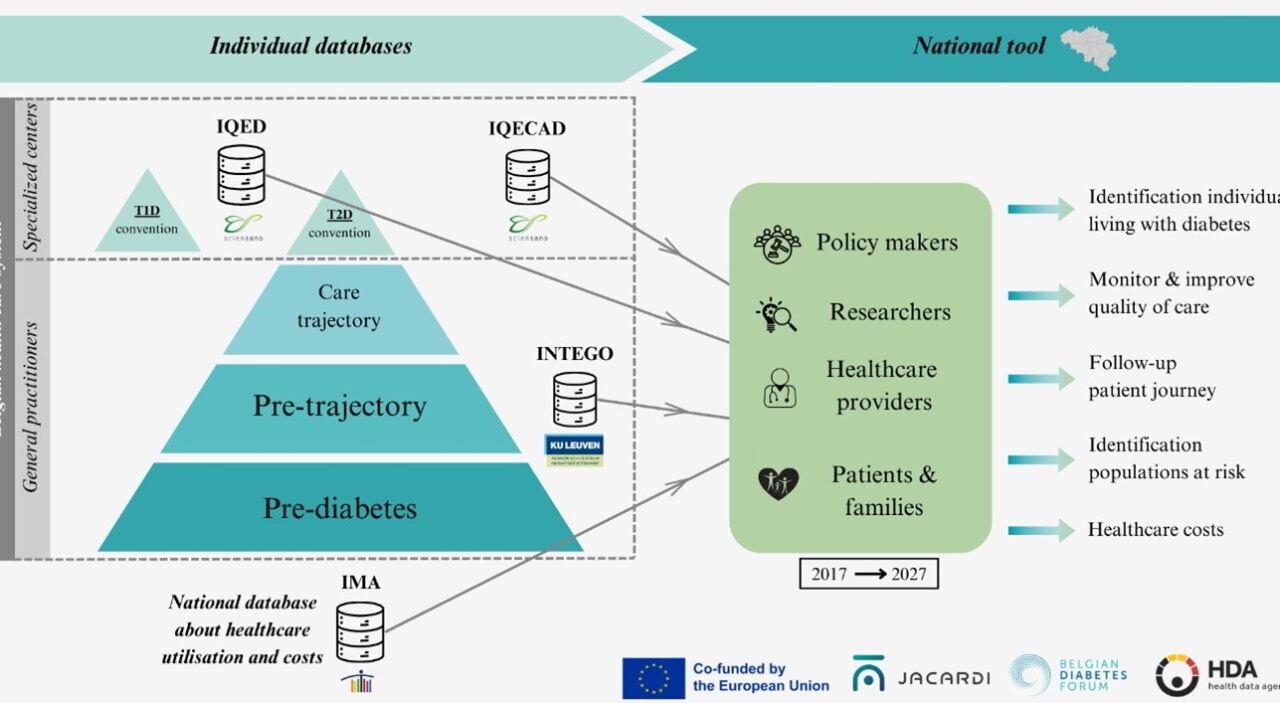
The next phase brings together three institutions: Sciensano, KU Leuven and the Intermutualistic Agency (IMA); each contributing complementary expertise in clinical epidemiology, health services research, and administrative data analysis. By combining these strengths, the consortium – together with the Belgian Diabetes Forum (BEDF) – will transform this linked dataset into a powerful tool for evaluating care quality, treatment patterns, patient pathways, outcomes, and costs.
The Diabetes Data Cell is more than a technical exercise in data linkage. It is a concrete step toward evidence-informed diabetes policy, supporting better planning, improved quality of care, and more efficient resource allocation. By turning routinely collected data into integrated, policy-relevant evidence, this project demonstrates how collaboration within JACARDI can directly strengthen chronic disease monitoring and decision-making at national level, with potential lessons for other countries and other non-communicable diseases.
Croí’s Healthy Hearts Club: empowering patients in heart disease self-management
Croí, the heart and stroke charity based in the west of Ireland, is leading one of Ireland’s pilot projects as part of JACARDI. This pilot, called the Healthy Hearts Club, focuses on patient self-management for those recovering from heart events, such as heart attacks. It aims to help individuals manage long-term health risks like high blood pressure and low physical activity. This project builds on Croí’s experience in heart disease prevention and rehabilitation and provides a crucial support system to patients after their initial cardiac rehabilitation.
A Sustainable Model for Long-Term Health
Cardiovascular disease remains the leading cause of death worldwide, and many patients face challenges in maintaining the positive changes achieved during rehabilitation. The Healthy Hearts Club offers a community-based model to help patients continue managing their heart health after formal rehabilitation ends.
“Cardiac rehabilitation is life-saving, but sustaining those changes is key to long-term health,” says Dr. Susan Connolly, Consultant Cardiologist at University Hospital Galway, who is a co-investigator on the project. “The Healthy Hearts Club provides ongoing support and helps patients stay on track with their health goals.”
The programme involves up to 160 patients, all of whom have completed cardiac rehabilitation through the through the Irish health service in Galway. Participants engage in six months of support, including regular nurse check-ins and group workshops on exercise, nutrition, emotional wellbeing, and heart disease risk factors. This ongoing support aims to help participants integrate these healthy habits into their daily lives.

Supporting Long-Term Change through Personalised Care
The Healthy Hearts Club emphasizes peer support, personalized care, and group activities tailored to the participants’ needs. By joining the programme soon after rehabilitation, patients are given the tools to continue the progress they’ve made, ensuring sustainable change over the long term.
“We believe that empowering people with the knowledge and tools to manage their health is essential for sustainable, person-centered care,” says Dr. Lisa Hynes, Head of Health Programmes at Croí. “This initiative aligns perfectly with our commitment to delivering innovative prevention and self-management programmes.”
In addition to in-person support, Croí will explore the use of digital health tools to further enhance the programme. Building on the success of Croí’s previous online self-management programme, the Healthy Hearts Club will assess how digital solutions can support long-term heart health.

A European Approach to Heart Disease Prevention
One of JACARDI’s goals is to integrate best practices across the entire patient journey—from screening and self-management to integrated care and workforce reintegration. The Healthy Hearts Club is a key component of this effort, with the programme’s evaluation aiming to develop scalable models for improving heart disease management across Europe.
“We’re excited to see how this project evolves and contributes to the broader European conversation on heart health,” says Dr. Connolly. “The insights we gain will help improve the long-term care and outcomes for patients.”
A Collaborative Effort for a Healthier Future
Croí’s leadership in the Healthy Hearts Club is part of the wider JACARDI programme, which connects Irish experts with a pan-European network of professionals working to reduce the burden of cardiovascular disease and diabetes. Dr. Hynes adds, “This collaboration with the HSE and European partners is a unique opportunity to learn from each other and translate research into real-world improvements in care.”
Mitja Lainscak: My hope is that we can intervene earlier for more patients
“It’s important that the JACARDI initiative and its outcomes gain visibility within the scientific community”, stresses Mitja Lainscak, Professor of Internal Medicine at the University of Ljubljana and member of JACARDI’s Scientific Advisory Board. As a clinical practitioner and researcher, he anticipates that collaboration will be one of the most important positive outcomes of the project, along with effects going from the regional or national level to the international level.
What significance does JACARDI hold for you and your organization?
I think that the organisations involved really appreciate being part of such a large initiative, trying to bring together efforts in the field of cardiovascular medicine and diabetes and to stimulate some potential cross-talk between the partners. The consortium is hosting more than 140 pilot projects with some of them related within or across the field.
One of the main benefits of an initiative like this, is that people talk to each other and realise that they can collaborate, so that their efforts can be transferred from the regional or national level to the international level.
How do you see JACARDI’s role in tackling the increasing prevalence of cardiovascular disease and diabetes in Europe?
Our society is aging and that’s an unavoidable reality. Advances in medicine have played a significant role in this trend. In addition, improvements in detection tools and the capabilities of our healthcare system have enhanced our ability to identify patients more effectively.
I hope we will identify more people at risk, as well as those with single or multiple conditions. Early detection is crucial because it allows us to start treatment earlier in the course of the disease, rather than waiting until it has progressed and caused irreversible damage. My hope is that we can intervene earlier for more patients.
How do you think JACARDI will influence future collaboration on cardiovascular disease and diabetes prevention in Europe?
JACARDI is a Joint Action, supported by the European Union and recognised by the scientific community. In a previous newsletter, I read a message from Professor Thomas F. Lüscher, the President of European Society of Cardiology highlighting the importance of JACARDI in shaping the future of cardiovascular disease and diabetes management through collaborative, data-driven care for the benefit of patients. I believe a similar message will come from the diabetes community. So, as said previously, having like-minded experts in the same room encourages discussion and cross-fertilisation of ideas. I anticipate that participants will begin to collaborate outside of the JACARDI framework, which I see as a positive outcome.
The European Society of Cardiology and the diabetes associations are already aligned, and I believe JACARDI has a crucial role to play in promoting future collaboration.
It’s important that the JACARDI initiative and its outcomes, such as pilot results, gain visibility in the scientific community. Researchers need to present their findings at conferences and submit their work for publication. This is essential to demonstrate that the funding received has been used effectively. Ultimately, it’s important to ensure that the investments made produce tangible results.
Based on your experience as a cardiologist, what do you consider the most critical factors in improving data-driven healthcare outcomes?
This is an extremely important question. Speaking from a national perspective, as someone from Slovenia, I’d like to extend this to an international context.
I believe that the lack of IT support for collecting data is a crucial issue. Slovenia is a small country with 2 million inhabitants and 14 hospitals, but we lack a unified IT system across these institutions. Although all hospitals are publicly owned and we have a single insurance provider, we struggle to collect comprehensive epidemiological data. We have a national hospitalization database, but it doesn’t give you the granularity of patient data.
The first necessary step would be the development of IT solutions, possibly using artificial intelligence, to extract the necessary data from medical records, particularly in terms of epidemiology. In my opinion, we still lack accurate figures for many diseases, both in Slovenia and across Europe.
Without this data, we cannot fully understand the scope of the problem, making it difficult to effectively allocate resources for patient management. I believe that the JACARDI pilots will showcase best practices in addressing this epidemiological data gap.
In terms of how JACARDI’s research and initiatives could support lasting, practical changes in clinical practice across Europe, particularly in Slovenia, I anticipate that most findings will primarily reflect the pilot country’s specific context . However, some lessons can be adapted across borders. Each country involved will focus on its specific challenges, but I believe that through meetings like this, where participants are encouraged to share their work, others can identify relevant lessons.
The perspective of the Advisory Board members is crucial in this process, as we aim to integrate ideas from different work packages that may not always communicate effectively with each other. This collaboration is essential.
Dr. Mitja Lainscak is a Professor of Internal Medicine at the University of Ljubljana and conducts clinical practice and research at the Department of Internal Medicine, General Hospital Murska Sobota, Slovenia. He is the Director of the Slovenian Research Agency and his clinical and research interest is cardiovascular medicine with particular emphasis on heart failure, pharmacotherapy, and metabolism with body composition. He has published more than 170 papers and holds an Executive Committee member position at the Heart Failure Association of the ESC.
Learn more about Mitja Lainscak and his work and connect on LinkedIn.